Give agents a system, not a blank canvas
Why bounded choices, generated contracts, and actionable validation make agents more useful website collaborators.

2026-08-19 · 5 minute read
A component becomes infrastructure when its schema, guidance, examples, semantics, runtime, and tests travel together.

A reusable component is not just a renderer. It is an agreement between authors, implementers, reviewers, browsers, and every future site that adopts it.
Teams often call a piece of reusable markup a component. That is enough to reduce copy and paste, but it is not enough to create a dependable authoring system.
A website component needs to answer questions for several audiences at once:
Sights keeps those answers beside the renderer in one manifest-backed definition.
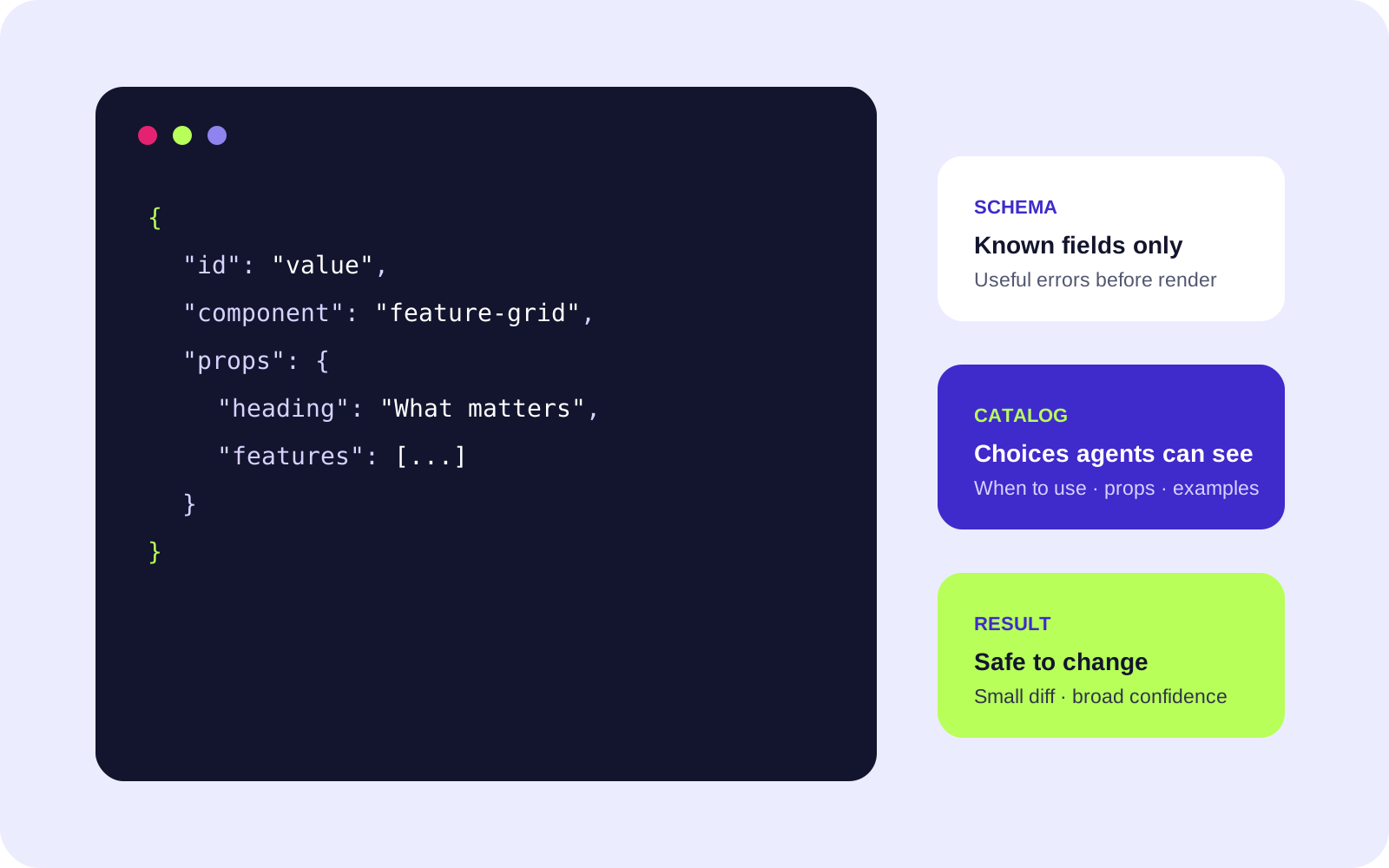
The props schema becomes runtime validation, an exported JSON Schema, inferred TypeScript, generated agent documentation, and the data contract shown in the component viewer.
The authoring guidance becomes catalog search text and human-readable documentation. Examples become review routes and test fixtures. Runtime declarations become page capability output. A semantic thumbnail preset becomes the catalog's visual cue without introducing maintained screenshots.
This is less glamorous than a new animation. It is also what keeps the system from lying to its users six months later.
If authors receive only stacks, grids, columns, headings, and boxes, the page file becomes a low-level layout program. Responsive decisions, heading relationships, spacing, and content priority leak back into declarative data.
Sights keeps primitives in trusted implementation code. Page authors choose complete responsibilities such as hero, feature grid, FAQ, comparison table, showcase, or call to action.
That makes the component opinionated enough to test and the page flexible enough to tell a story.
Not every unique section belongs in the platform. A consumer can register a site-owned component through the same contract and prove it against one real need.
Only after several consumers need the same responsibility should the pattern move into Sights. By then, the prop vocabulary, responsive behavior, accessibility constraints, and useful variants are grounded in evidence rather than speculation.
This is how the catalog compounds without becoming a warehouse of nearly identical components.
When a shared component fixes a keyboard bug, image crop, heading relationship, narrow-screen order, or overflow issue, every site using that contract can benefit. The canonical demo proves the behavior across themes, examples, pages, and browser engines before the change travels.
That is the real economic value of a component system: not fewer files, but fewer solved problems becoming local again.
Keep reading
Why bounded choices, generated contracts, and actionable validation make agents more useful website collaborators.